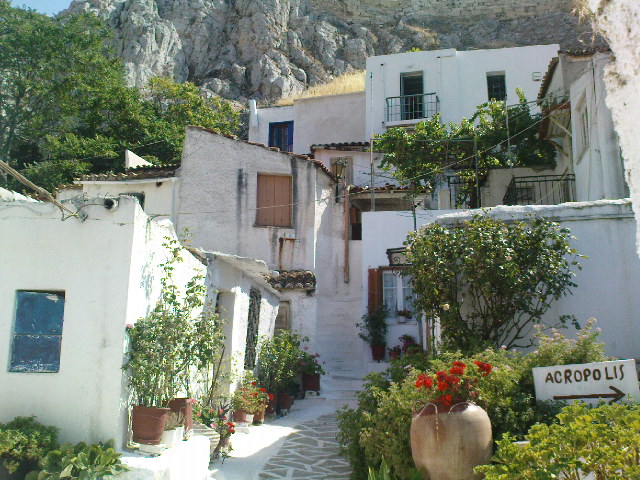

White houses, small courtyards, narrow passageways and steps that bring the Cyclades to mind. Yet Anafiotika is not on an Aegean island. It lies in Athens, directly beneath the Acropolis rock, and owes its existence to the craftsmen who arrived from the small island of Anafi in the 19th century.
Its story begins when Athens, after being declared the capital of the newly established Greek state, was turning into a vast building site.
The famed builders of Anafi
The people of Anafi were known for their skill in construction. The Ephorate of Antiquities of the Cyclades notes that, in the mid-19th century, builders from Anafi were recruited for the rebuilding of Athens and the construction of King Otto’s palace, today’s Parliament building.
The workers also needed somewhere to live. So they began building small houses on the north-eastern side of the Acropolis rock — and built exactly as they knew how.
They brought the architecture of their island to Athens: compact volumes, whitewashed walls, flat roofs, narrow passageways and courtyards adapted to difficult ground. That is how a tiny Cycladic neighbourhood came to exist in the heart of the capital.
The houses that, according to tradition, were built at night
One of the best-known stories identifies the first settlers as the carpenter Giorgos Damigos and the builder Markos Sigalas.
Residents built without a formal planning process, and researchers regard Anafiotika as one of the first informal settlements of the modern Greek state.
Tradition has it that several houses were built at night, so quickly that the area was even proposed to be called “Night Village”. In the end, the name Anafiotika prevailed, after the origins of its first residents. The account also appears in historical references to the urban development of Athens.
From the people of Anafi to refugees from Asia Minor
For decades, the neighbourhood retained a strong Cycladic character. After the Asia Minor Catastrophe of 1922, refugee families also settled there, gradually changing the population’s composition.
The neighbourhood itself later began to shrink. Part of it was demolished around 1950 for archaeological research, while expropriations followed in subsequent decades because of its immediate proximity to the Acropolis archaeological site. Today, about 45 houses remain, protected as listed buildings.
A neighbourhood without ordinary streets
Even today, many of Anafiotika’s lanes have no names. The houses are identified by numbers such as “Anafiotika 1”, “Anafiotika 2”, and so on.
The small district’s notional boundaries are marked by two old churches: Agios Georgios tou Vrachou (St George of the Rock) to the east and Agios Symeon to the west, both dating from the 17th century.
Anafiotika is therefore not a “set” designed for visitors. It is an imprint of 19th-century internal migration and of the people who built the new Athens but lacked the means to live in the city they were building.
Related (in Greek): Anafi is Europe’s quietest island (2026)
And perhaps that is its most compelling feature: beneath the most important monument of ancient Athens survives a small monument to modern Greece, built by the hands of craftsmen from one of the smallest islands in the Cyclades.
The neighbourhood took its name from the craftsmen and workers who came from Anafi in the 19th century and settled beneath the Acropolis.
The neighbourhood was established in the mid-19th century, during Athens’s major period of rebuilding.
About 45 houses remain, considerably fewer than existed originally.
Yes. The area is part of Plaka and can be reached on foot. The houses are real homes, however, so visitors should respect residents’ privacy.
The story that the people of Anafi built their homes at night is a long-standing and widely repeated account. Historical references describe night-time building, but that does not mean every house was literally built in a single night.
Also read (in Greek): From the Minalagia of Cyprus to the Merominia of Greece and the cabañuelas of Spain
Discover more from Agora Περιοδικό
Subscribe to get the latest posts sent to your email.