
New evidence from excavations at the Church of the Holy Sepulchre in Jerusalem, which houses the Holy Tomb, has revived one of biblical archaeology’s biggest questions: is this really the tomb in which, according to the Gospels, Jesus’ body was placed after the Crucifixion?
New archaeological discoveries beneath the Church of the Holy Sepulchre show striking parallels with the Gospel accounts, without proving that this particular tomb belonged to Jesus.
Archaeologists remain cautious in their answer. They cannot prove that the tomb belonged to Jesus. However, the new findings suggest that the landscape of the area around 2,000 years ago matches the Gospel narratives to a remarkable degree.
Tombs, cultivated land and an ancient quarry
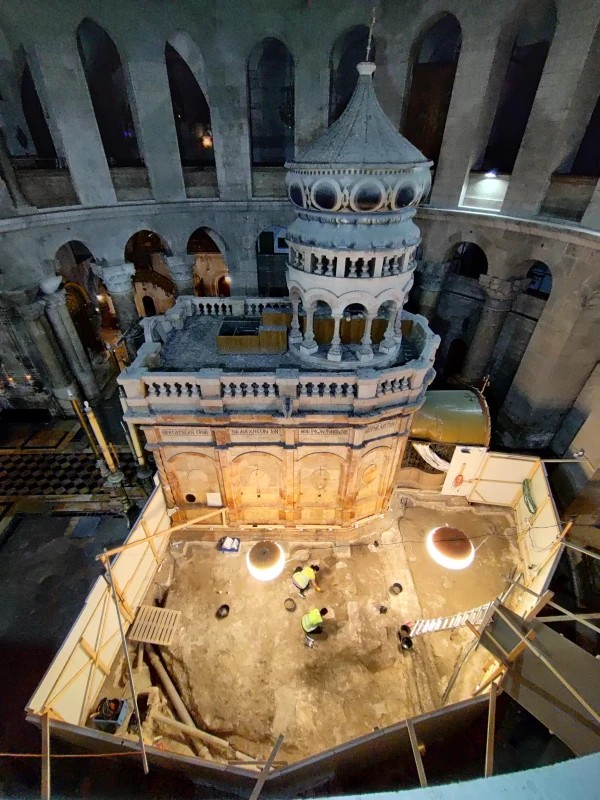
The excavations are being carried out by a team from Sapienza University of Rome, led by archaeologist Francesca Romana Stasolla. They began in 2022, alongside the restoration of the church’s floor.
Beneath the present building, researchers mapped an old quarry. After it was abandoned, parts of it were covered with soil and used for cultivation, and later for burials. Rock-cut tombs were found, along with traces of agricultural activity. The 2025 scientific report confirms the area’s successive use as a quarry, farmland and burial ground.
Archaeobotanical analyses have also identified plant remains, including grapevines, fig trees and cereals. The research is still under way and covers a very long period, from the Iron Age to modern times.
The striking similarity to the Gospel account
This is the detail that attracted international interest.
The Gospel of John states that at the place of the Crucifixion there was a garden, and in it a new tomb. The other Gospel writers describe the tomb as hewn from rock.
The excavations show that there were indeed cultivated plots and rock-cut tombs in the area. The site was also outside Jerusalem’s walls in Jesus’ time, which is consistent with ancient accounts of the place of the Crucifixion.
Why the Holy Sepulchre is considered a strong candidate
The tradition linking this site to Jesus is very old. In the fourth century, during the reign of Emperor Constantine, it was identified as the place of the Crucifixion and burial, and the first major Christian complex was built over it.
Scientific tests conducted during the restoration of the Holy Aedicule in 2016 indicated that the cladding of the tomb’s original rock dates to around AD 345, confirming that the site was already venerated in Constantine’s era.
Related reading: Stavrovouni Monastery
The latest excavations now strengthen this picture. Sapienza itself describes the site’s development as a transition “from quarry and garden to imperial basilica and global pilgrimage site”.
So, has Jesus’ tomb been found?
Not in the scientific sense of proof. Archaeology can show that the site was suitable for burials during the period in question, that it contained rock-cut tombs and cultivated land, and that its topography agrees with important details in the Gospels.
There is, however, no archaeological way to prove that a particular human body—that of Jesus of Nazareth—was placed in this particular tomb. The researchers themselves acknowledge this limit.
The new findings therefore do not solve the mystery. They do, however, make the traditional site of the Holy Sepulchre even more interesting from a historical and archaeological perspective.
Read also: 60 Hours Inside the Holy Sepulchre: The Greek Mission That Restored the Holy Aedicule
The findings are consistent with the Gospel accounts, but they cannot prove who was buried in this particular tomb.
An ancient quarry, cultivated land, plant remains and rock-cut tombs.
The Gospel of John says that there was a garden near the place of the Crucifixion, and in it a new tomb.
The well-known Garden Tomb was proposed in the nineteenth century, but archaeological dating places it in the Iron Age, many centuries before Jesus’ time.
You may also be interested in: “Palm Sunday, or Olive Sunday in Cyprus”
Discover more from Agora Περιοδικό
Subscribe to get the latest posts sent to your email.