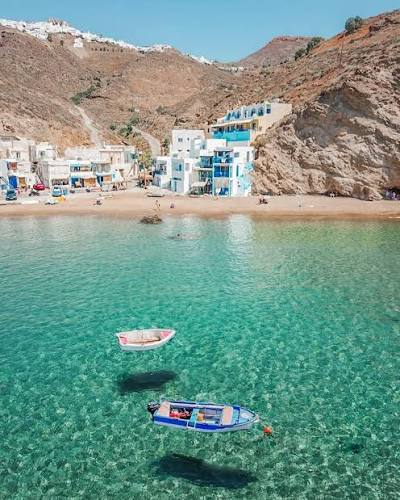
Anafi was named Europe’s quietest island for 2026, while Milos also made the list of the world’s 25 most “unspoilt” islands. Such recognition sounds positive. Yet there is a paradox: the more a place is promoted as quiet and unexplored, the more visitors it may attract—and eventually lose the very quality that made it appealing.
The ranking comes from BookRetreats’ first Unspoilt Index, which examined 100 islands. Anafi scored 93.8 out of 100 and placed second worldwide. Milos came 22nd with 69.8 out of 100. At the other end of the list, Santorini ranked 99th.
Read this too: Cyprus = sun and sea, full stop (in Greek)
What does the research actually measure?
There is an important detail here. The Unspoilt Index does not measure the number of tourists who visit each island.
Its score is based on six indicators: resident population density, natural environment, road-network density, air traffic, light pollution and access to natural coastal areas. The researchers themselves note that there is no single global database for actual island noise, so they use these indicators as proxies.
That means an island can be rated “quiet” while still facing heavy seasonal tourism pressure.
Also of interest: Paphos has some of the world’s best sunsets (in Greek)
In 2025, the study measured something different
A year earlier, BookRetreats had published a different study on Europe’s most and least crowded islands. That one used actual 2023 data and calculated tourist overnight stays per square kilometre.
The least burdened destinations included Svalbard, Åland, Chios, El Hierro and the Azores. The study itself warned, however, that its measure could not capture seasonality or the number of visitors a destination can genuinely sustain.
So the 2025 and 2026 positions cannot be compared as if they were the same ranking.
From “hidden gem” to popular destination
The concern that lists like these can change a destination is not unfounded. Academic research has found that exposure through social media can help concentrate large tourist flows in particular places. It is not the sole cause of overtourism, but it is a real one.
Milos is a characteristic example. An island presented until only a few years ago as a quiet choice in the Cyclades has gained considerable international attention. In 2024 alone, passenger traffic at its airport reached 117,795 passengers, up 22.46% from 2023.
Sifnos is even more revealing. Although it is not in this year’s top 25 of the Unspoilt Index, it recorded historically high ferry arrivals in 2025, up more than 9% by August. Ferryhopper booking data also showed an increase of around 30%. A study on tourism sustainability on the island had already pointed out that the heavy concentration of visitors in August puts pressure on water, waste and transport.
Could Anafi be next?
Anafi has fewer than 300 permanent residents, a small area and no airport. These are precisely the features that lifted it to the top of the ranking. At the same time, they mean it has far less capacity to absorb a sudden rise in visitors.
The answer is not to stop publishing such research. The answer is to protect the destination through rules—and laws—that are actually enforced. Lord Howe Island in Australia, which also ranks highly in the Unspoilt Index, allows roughly 400 visitors at any one time, helping it preserve its character.
And here lies the irony of so-called quiet tourism: the global search for a peaceful, “unspoilt” place can ultimately create the noise travellers are trying to escape.
According to BookRetreats’ Unspoilt Index, Anafi ranks first in Europe and second worldwide, with a score of 93.8 out of 100.
The ranking does not count tourists. It measures factors such as roads, air traffic, natural environment, resident population and light pollution. An island can therefore be environmentally “quiet” while experiencing intense tourism in summer.
International publicity, the media and especially social media can quickly focus attention on a previously lesser-known destination. The risk is greater for small islands with limited infrastructure.
Discover more from Agora Περιοδικό
Subscribe to get the latest posts sent to your email.