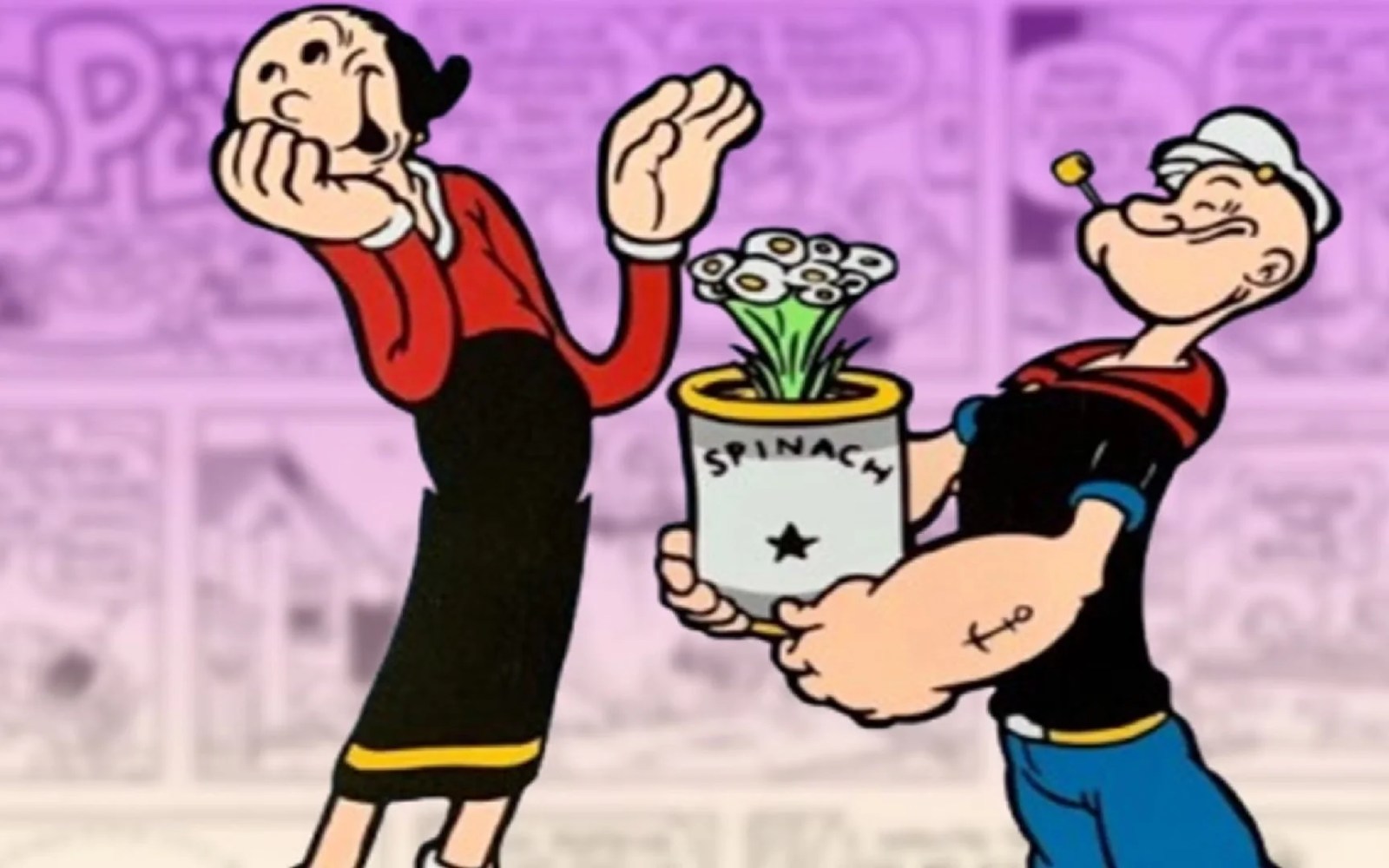

Popeye is so closely associated with cartoons and spinach that it is easy to forget he was born neither on television nor in the cinema. He first appeared on 17 January 1929 in the newspaper comic strip Thimble Theatre, created by American cartoonist E. C. Segar. Initially, he was a supporting sailor hired for a voyage. His popularity, however, quickly made him the central character.
His first appearance in the cinema
Popeye became a film character on 14 July 1933. He appeared in the seven-minute black-and-white cartoon Popeye the Sailor, produced by Fleischer Studios and distributed by Paramount Pictures. Technically, the film belonged to the Betty Boop series, and Boop made a brief appearance. In practice, however, it marked the screen debut of Popeye, Olive Oyl and Bluto.
The same film introduced Sammy Lerner’s song ‘I’m Popeye the Sailor Man’. A few months later, Popeye’s own series of theatrical short films followed. Fleischer Studios produced 105 black-and-white films and three Technicolor specials between 1933 and 1942, according to the Library of Congress.
When he became a television hero
The theatrical shorts were later shown on television. The first series made specifically for television distribution, however, arrived in 1960, when King Features Syndicate introduced a new series called Popeye the Sailor.
Hanna-Barbera’s The All-New Popeye Hour followed on CBS in 1978. In 1980, the character returned to the big screen in live action. Robert Altman directed the musical Popeye, with Robin Williams in the title role and Shelley Duvall as Olive Oyl. These dates are recorded in Popeye’s official timeline.
When he started eating spinach
Popeye did not eat spinach from his first appearance. His earliest known connection with the vegetable is found in a comic strip dated 26 June 1931. In Segar’s stories, he was already extraordinarily strong and almost invulnerable. Spinach appeared occasionally as a healthy food, rather than always acting as instant ‘magic fuel’.
Fleischer Studios’ cartoons changed that pattern from 1933. To give the short stories a quick, recognisable climax, Popeye would open a can, eat the spinach and defeat his opponent. One of the most famous recurring devices in cartoon history was born.
The choice was not based, as is often claimed, on an error that overstated spinach’s iron content tenfold. In a 1932 strip, Popeye himself attributed spinach’s value to vitamin A. In addition, American public-health campaigns in the 1920s promoted foods such as spinach as part of efforts to address childhood malnutrition. The character turned that nutritional message into a popular image of strength.
Did you know? The ‘real Popeye’: The story of Frank ‘Rocky’ Fiegel
What the name ‘Popeye’ means in Greek
The name plays on the English expression ‘pop-eye’: an eye that stares intensely, protrudes or bulges. A loose Greek rendering would be ‘Gourlomatis’ or ‘Petachtomatis’, both suggesting a person with bulging eyes. It is not a naval rank, nor does it literally mean ‘one-eyed’, although the character is usually drawn with one eye closed.
How should Popeye’s name be pronounced?
In the original American pronunciation, it sounds like ‘POP-eye’, with the main stress on the first syllable. The closest Greek phonetic rendering is therefore ‘Πόπαϊ’. The spelling ‘Ποπάυ’ is established in Greece, while ‘Πόπαϋ’ is used in Cyprus, but these conventions do not precisely reproduce the English stress.
From a passing character in 1929, Popeye became a film star, a television hero and a worldwide symbol. His name, face and spinach created an image that remains recognisable almost a century later.
On 17 January 1929, in E. C. Segar’s newspaper comic strip Thimble Theatre.
On 14 July 1933, in Fleischer Studios’ cartoon Popeye the Sailor.
In 1960, when King Features Syndicate created a new series for television distribution.
His earliest known connection with spinach appeared on 26 June 1931. The theatrical cartoons established the can as a source of instant strength from 1933.
It refers to an eye that protrudes or bulges. A loose Greek rendering would be ‘Gourlomatis’ or ‘Petachtomatis’.
In the original American pronunciation, it sounds like ‘POP-eye’, with the main stress on the first syllable. The closest Greek phonetic rendering is ‘Πόπαϊ’. The established spelling ‘Ποπάυ’ does not precisely reproduce the English stress.
Discover more from Agora Περιοδικό
Subscribe to get the latest posts sent to your email.