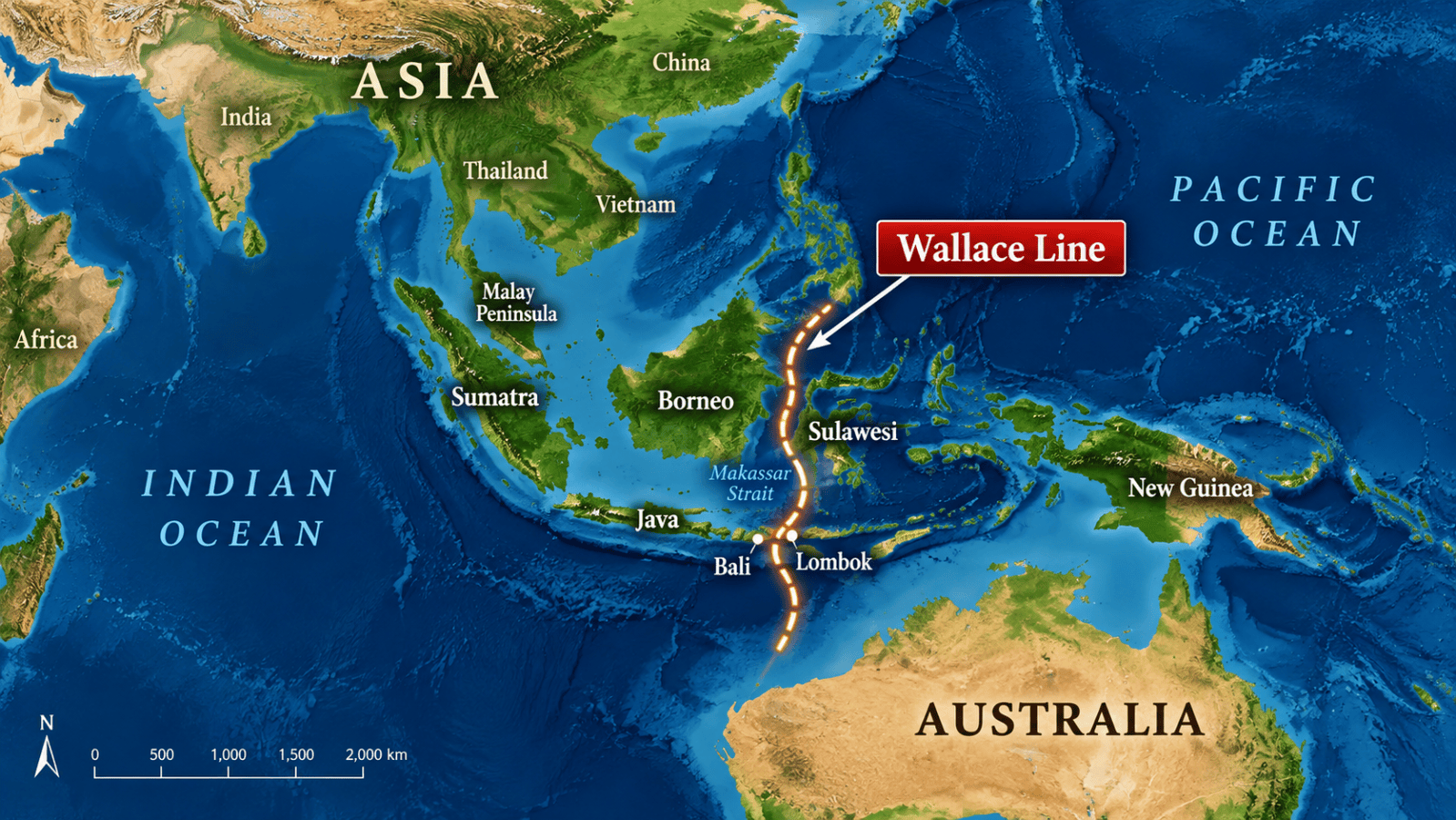
In Indonesia, between the islands of Bali and Lombok, lies one of the planet’s most fascinating natural boundaries. There are no fences, mountains or other visible dividing lines. There is only the sea.
Yet this stretch of water, around 35 kilometres wide, is enough to separate two areas with strikingly different evolutionary histories.
The phenomenon is known as the Wallace Line, named after the British naturalist Alfred Russel Wallace.
Two different worlds, 35 kilometres apart
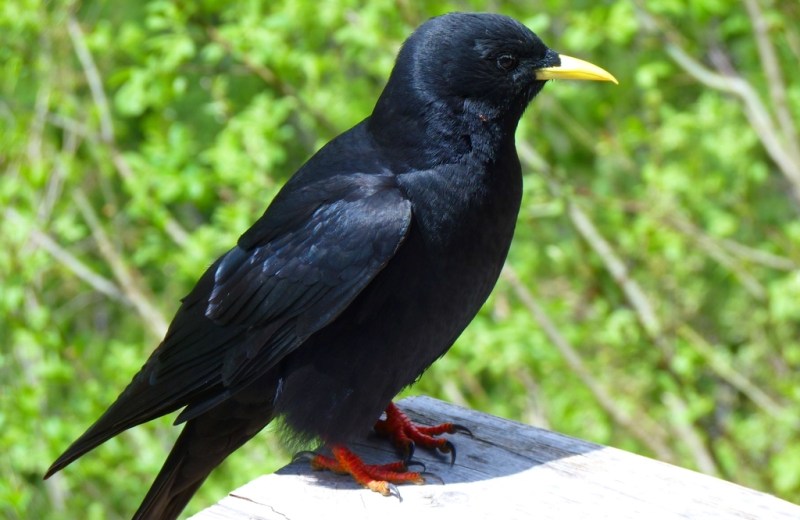
West of the line, on Bali and other islands, animals with evolutionary links to Asian fauna predominate. To the east, on Lombok and neighbouring islands, a different mix of species appears, with characteristics associated with the wildlife of Australia and the wider Oceanian region. Wallace noticed that even the birds differed markedly between the two islands.
How could two places so close together geographically be home to such different animal populations?
The secret lies on the seabed
The explanation lies hundreds of metres below the surface of the sea. The Lombok Strait is deep, reaching depths of at least 250 metres in places.
During the ice ages, ocean levels fell significantly. Large areas of present-day Indonesia were then connected to mainland Asia, allowing land animals to move between them. However, the deep channel between Bali and Lombok remained a sea barrier.
As a result, many animal populations evolved separately over vast spans of time.
You may also be interested in: What is the most intelligent animal after humans?
Why do even some birds not cross?
Most strikingly, the barrier affects even species that can fly. Many forest birds avoid open stretches of sea, while others struggle to establish themselves in a different ecosystem, even if they manage to reach it.
This does not mean that no animal crosses the line, as some online videos claim. Birds, bats and marine organisms can cross it.
The line is a biogeographical boundary, not an impenetrable physical wall.
Read more: Scientific breakthrough: a live colossal squid in Antarctica
A discovery that helped us understand evolution
Alfred Russel Wallace studied the region’s wildlife in the 19th century. His observations contributed to the development of biogeography and our understanding of how species evolve. He formulated the idea of natural selection independently of Charles Darwin.
Modern genetic and biogeographical research confirms that the Wallace Line corresponds to a striking change in the composition of animal communities.
The paradox remains fascinating: two islands, just 35 kilometres apart, reveal how a relatively narrow sea passage can shape the evolution of life over millions of years.
Sources
The distance of 35 kilometres comes from a scientific study published in 2021 in Global Ecology and Biogeography and is corroborated by educational material from the Royal Botanic Gardens, Kew, and Oxford University Press. This is the distance between Bali and Lombok; the narrowest part of the strait, between Lombok and the smaller island of Nusa Penida, is around 18 kilometres wide.
- Scientific study – Global Ecology and Biogeography (2021)
- Royal Botanic Gardens, Kew – Alfred Russel Wallace
- National Geographic – map and biogeographical explanation
- International Maritime Organization – Lombok Strait data
Discover more from Agora Περιοδικό
Subscribe to get the latest posts sent to your email.