For centuries, the name of the Huns was synonymous with absolute terror. Roman historians portrayed them as “monsters” who destroyed Europe. Modern science and journalistic research, however, challenge that picture. Who were these seemingly invincible warriors of the steppe, what became of them, and are there peoples today who can claim Attila’s legacy?
Who were the Huns? Their origins and the “storm” over Europe
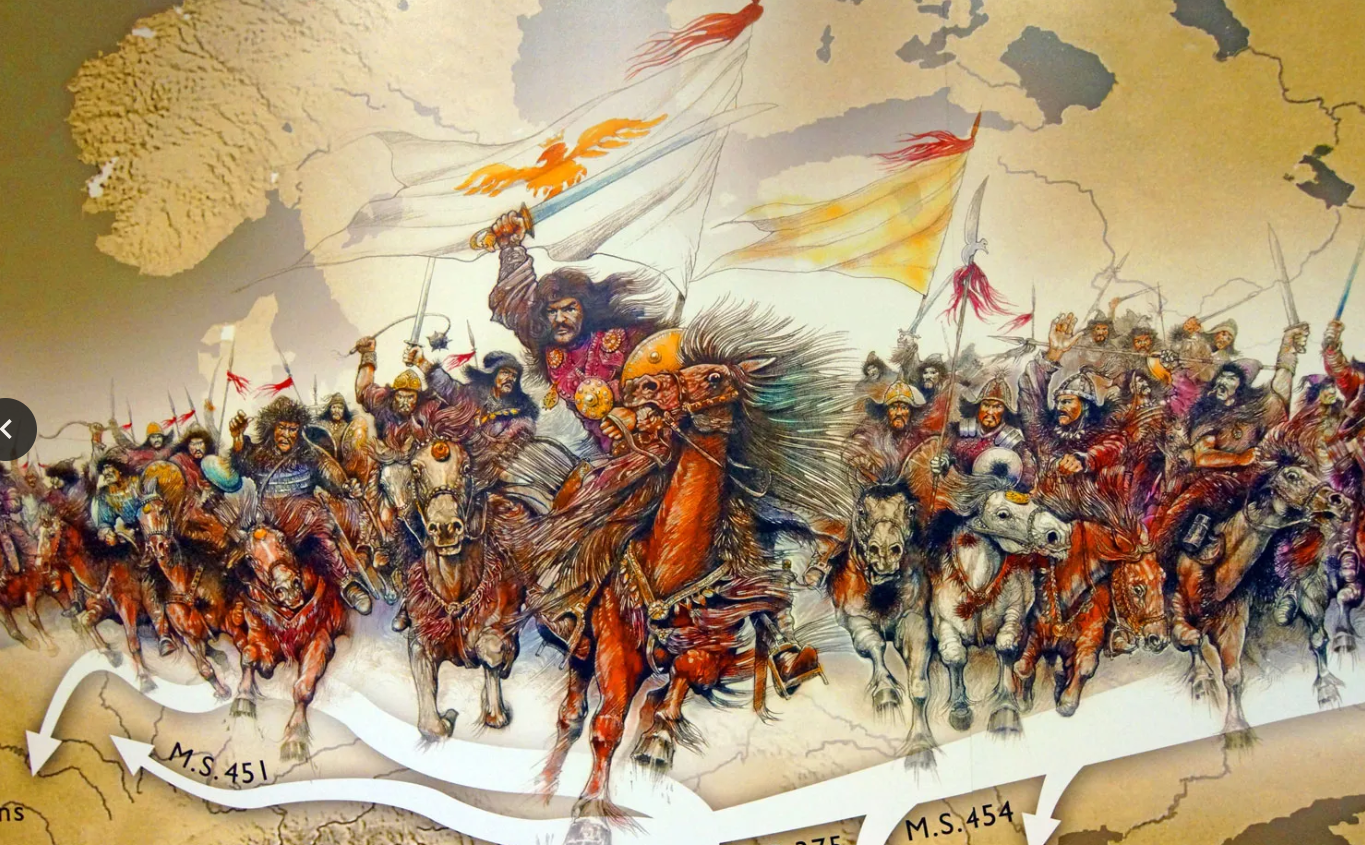
The Huns appeared on Europe’s borders around AD 370. They were a remarkably dynamic nomadic people with formidable military skills. They built no cities and did not cultivate the land. Instead, they lived on horseback and moved constantly.
According to recent genetic research, their original roots lay in East Asia. In particular, they are linked to the Xiongnu, a powerful confederation of nomads that threatened China. When that confederation collapsed, they began moving west. Over the decades, they mixed with other Eurasian populations, creating a multi-ethnic mosaic.
Their arrival in Europe set off an unprecedented domino effect. They exerted violent pressure on Germanic tribes such as the Goths, forcing them into the Roman Empire. This “Great Migration of Peoples” changed the map of the continent forever.
The secret of their military superiority
Why could no one stop the Huns? The answer lies in their military technology.
- The composite bow: They used a revolutionary bow made of wood, horn and sinew. It had great power and range.
- Mastery of horsemanship: The Huns could aim accurately while galloping at great speed.
- Psychological terror: Their appearance inspired awe. They also artificially reshaped the skulls of elite children, binding them tightly so that they acquired an elongated form.
Under the leadership of Attila, their empire reached its peak. It stretched from Germany to the Volga River. Yet after Attila’s death in AD 453, their power disappeared almost immediately because of internal civil wars.
Which peoples are descendants of the Huns today?
This is the most fascinating question in historical research. After the collapse of their empire, the Huns did not vanish from the planet. Instead, they were assimilated by other peoples.
1. Hungarians (Magyars): the historical connection
The link between Hungary and the Huns is the most famous. In English, the country is called Hungary — the land of the Huns. Medieval Hungarian legends regard Attila as their own king, while the name “Attila” remains especially popular. Modern genetics, however, shows that Hungarians are mainly a European people, with only very small percentages of Asian DNA that could be connected directly to the Huns.
2. Bulgarians: the Proto-Bulgarians of the steppe
The early Bulgarians, or Proto-Bulgarians, were a nomadic people who moved towards the Balkans. Many historians believe that they were close relatives of the Huns or formed part of their confederation. The royal dynasty of the early Bulgarian rulers, the Dulo dynasty, claimed direct descent from Attila.
3. Peoples of Central Asia and Russia
After their defeat, many Hunnic tribes retreated towards the Black Sea and Central Asia. There they mixed with Turkic and Mongol peoples. Today, groups such as the Chuvash, an ethnic group in Russia, and some communities in Kazakhstan are thought to have the closest linguistic and genetic relationship with the ancient Huns.
The ideological link in Turkey today
In Turkey’s official state historiography, the Huns are regarded as the direct ancestors of the Turkish nation.
- Attila is regarded as one of history’s greatest “Turkish” commanders.
- The name Attila is particularly common and popular for boys in modern Turkey.
- On the emblem of the Turkish Land Forces, the army’s founding year is officially given as 209 BC, a date that coincides with the founding of the Xiongnu Empire — the Asian Huns — by Modu Chanyu.
And the Finns?
- The Finns’ real origins: The ancestors of the Finns lived in north-eastern Siberia, in the Yakutia region, about 4,500 years ago. From there they moved towards the distant European north, in the Baltic region and present-day Finland.
- Genetic isolation: Finns do indeed have a small proportion of Siberian DNA, around 7–10%. However, the remaining 90% of their genetic makeup comes from indigenous European hunter-gatherers and their Scandinavian neighbours.
- Geographical distance: The Huns were nomads of the warm steppe. They never moved into the frozen forests and marshes of the north where Finns lived, as the area had neither wealth to plunder nor terrain suited to their horses.
What science concludes
In conclusion, there is no single people today who can be described as the “pure” descendants of the Huns. From the outset, the Huns were a union of many different ethnic groups. Their DNA is now scattered across Eurasia, from the plains of Hungary to the steppes of Mongolia. What is certain is that, despite their brief presence, they changed the course of world history forever.
Discover more from Agora Περιοδικό
Subscribe to get the latest posts sent to your email.