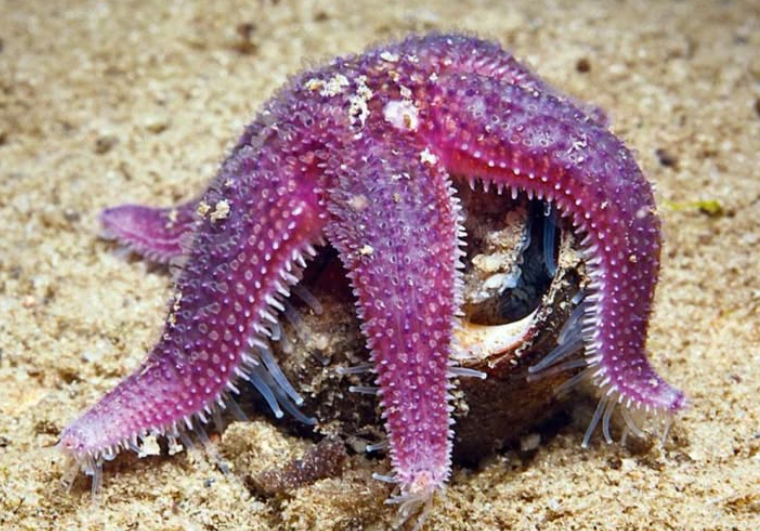

It happens every day on the seabed: many species of starfish can push part of their stomach outside their body. This allows them to eat animals that would never fit through their small mouth.
Starfish are not fish. They belong to the echinoderms, along with sea urchins and sea cucumbers. Their mouth lies in the centre of the underside of the body—the side facing the seabed.
How a starfish opens a closed mussel
When a starfish finds a mussel, oyster or another bivalve mollusc, it wraps its arms around the shell. Hundreds of tiny tube feet then attach to its two halves.
The starfish does not need to break the shell. It applies a steady pull until the muscle holding the two halves shut tires. Once a tiny gap opens, the most remarkable part of the process begins.
Digestion begins outside the body
The starfish pushes its so-called cardiac stomach out through its mouth. It spreads it over or inside the prey and releases digestive enzymes. These break down the prey’s soft tissues into material the starfish can absorb.
The first stage of digestion therefore takes place outside the body. The starfish then pulls its cardiac stomach back inside. Its pyloric stomach and digestive glands continue processing the nutrients. Smithsonian Ocean has documented this process in detail in starfish feeding on mussels.
Not all starfish eat in the same way
The claim that all starfish push their stomach outside their body is an oversimplification. Many species use this technique, but not all. Some swallow small molluscs, crustaceans or other organisms whole.
Their diet also varies by species. Some eat mussels, oysters and snails. Others consume sponges, corals, small crustaceans or dead organic matter. Starfish are therefore far more than motionless, decorative creatures. They are active predators with a significant influence on the balance of marine ecosystems.
In Cyprus too
The spiny starfish Marthasterias glacialis, which also lives in the Mediterranean, opens bivalve molluscs with its tube feet and extends its stomach inside the shell. The red starfish Echinaster sepositus has been officially recorded in Cyprus. This species spreads its stomach over the substrate to feed on small organisms and organic material. Similar sights can therefore indeed be observed in Cypriot waters, although the prey is not necessarily a mussel.
No. The starfish mainly extends its cardiac stomach, which remains connected to its digestive system.
Yes. It uses its tube feet to apply a continuous pull until a small gap opens.
No. Their diet depends on the species and may include corals, sponges, snails, crustaceans or organic debris.
Read also
Blue crab: The non-native species that became a prized delicacy
The Mediterranean is changing: The non-native species that have reached Cyprus
Nurse shark: The truth behind the viral video
Discover more from Agora Περιοδικό
Subscribe to get the latest posts sent to your email.